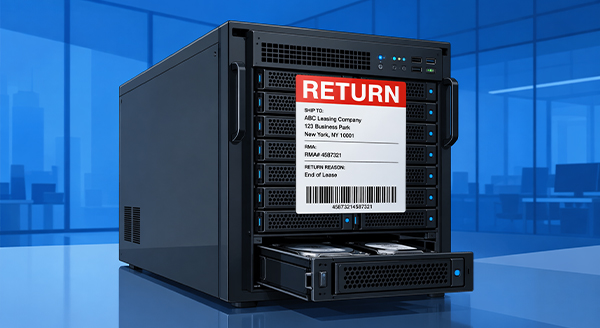
What Happens to Your Leased Equipment When the Contract Runs Out?
Most hardware leases are signed, filed, and promptly forgotten. The servers arrive, get configured, and start doing their job. Then three or four years pass, and nobody tracks the contract end date, so a renewal notice arrives thirty days before the term expires. That’s not enough time to plan anything properly.
Your data leaves with the hardware
When a leased server or workstation reaches end of term, the equipment goes back to the finance company, not to an IT provider or a vetted recycler, but to a company whose business is lending money against assets, not managing your sensitive files. They remarket returned equipment, and what is on the drives is not their concern.
A factory reset does not wipe a drive securely. Files can be recovered from a reset machine using freely available tools, and anything stored locally, including customer records, financial documents, and cached credentials, can survive a return in a readable state.
The documentation problem
The other issue that surfaces at lease end is that the hardware going back often has no paper trail inside the business. The IT person who configured the servers left two years ago, and nobody knows if the equipment was domain-joined, whether it was running a backup agent, what software was licensed specifically to that machine, or whether it held a local copy of anything important. The lease end date triggers a scramble to find out what the business actually has before it disappears out the door.
Knowing exactly what hardware you own or lease, what is running on it, and when each item is due back is the kind of discipline that feels optional right up until it is not.
The compliance angle
Depending on your industry and the type of data your business holds, returning a drive with client information on it may not just be careless; it may breach your privacy obligations. The fact that the finance company did not wipe the drive is not a defense. Your business put the data on that machine and is responsible for what happens to it. A certificate of secure destruction from a qualified provider closes that loop; without it, you have no proof of compliant disposal.
Timing works against you
Equipment refreshes are not quick. Replacement hardware has lead times, and configuring new servers takes time that needs to be scheduled well in advance. If the lease ends mid-project or right before a busy period, you are either running on equipment you no longer own or rushing a replacement into place without proper testing.
Planning a refresh months out means you get the overlap period you need: new equipment is configured and tested before the old gear leaves, and there’s no gap in service or last-minute scramble.
What proactive lease management looks like
A managed IT provider tracks hardware lease end dates as part of ongoing asset management. The refresh conversation starts months out, not weeks; secure data wiping is handled before equipment is returned, with documentation to prove it; and replacement hardware is specified, ordered, and ready before anything gets disconnected.
Treating a lease end as a data security event, well ahead of the date, is a straightforward way to avoid a problem that catches many businesses completely off guard.
Let's take a look
If you have leased hardware in your business and are not certain where you stand, get in touch, and we will find out together before a deadline forces the decision.
